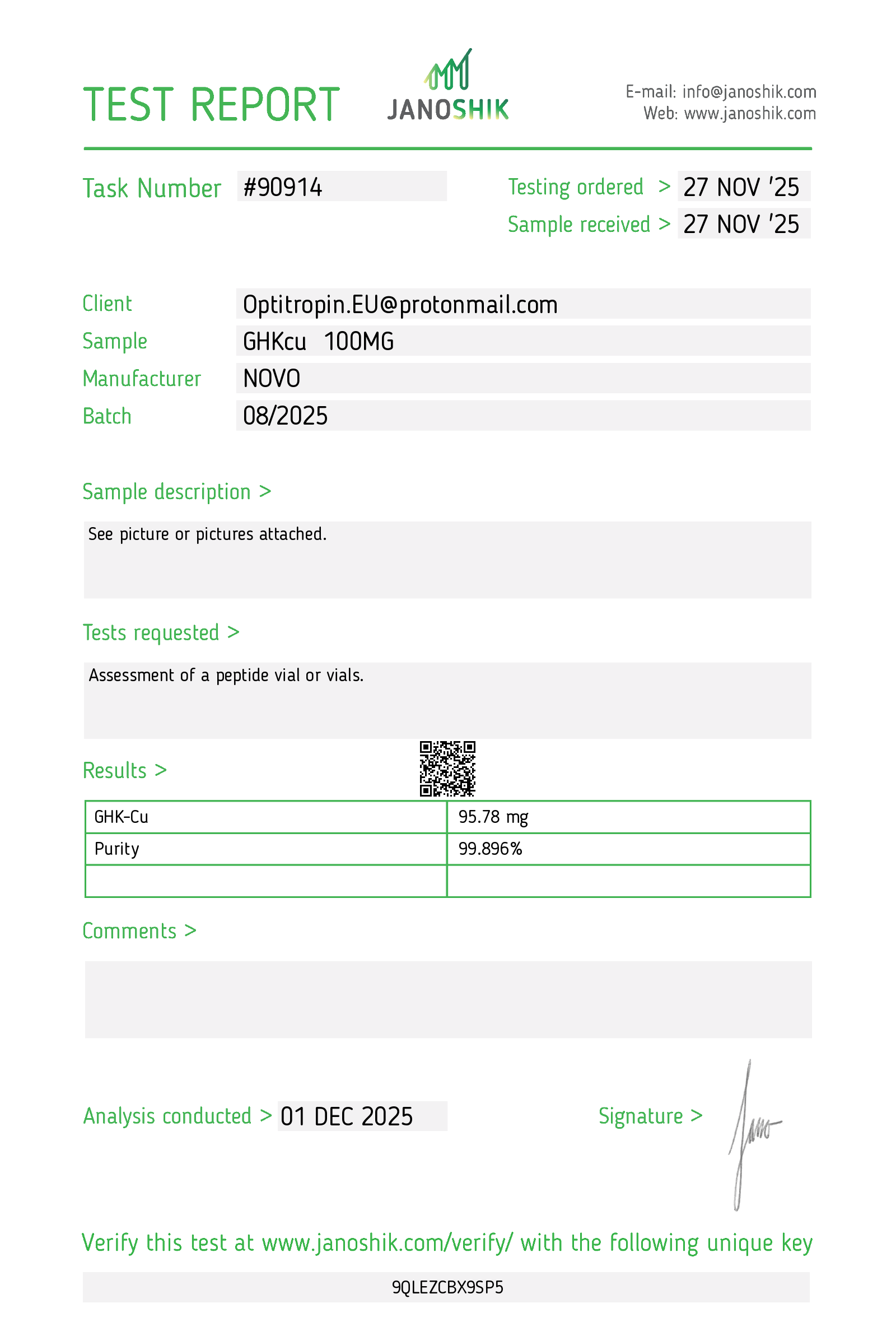
GHK-Cu 100 mg (Glycyl-L-histidyl-L-lysine Cu)
€ 70,00
Out of StockBuy premium GHK-Cu 100 mg | Novo online. High purity, lab-tested, and fast shipping. Ideal for skin and hair rejuvenation. Order GHK-Cu securely today!
Acne
No
Half-Life
10 Minutes
Dosage
1-5mg Daily
Detection Time
24 Hours
Aromatization
No
Water Retention
No
Hepatotoxicity
No
HBR
No
Product Information
About GHK-Cu 100 mg (Glycyl-L-histidyl-L-lysine Cu)
The Holy Grail of Skin Rejuvenation
GHK-Cu (Copper Peptide) is scientifically renowned for its ability to reset the aging gene expression of skin cells to a healthier state. It massively stimulates collagen and elastin production, tightens loose skin, improves elasticity, and reduces fine lines and wrinkles.
Beyond skincare, GHK-Cu is clinically proven to accelerate wound healing and stimulate hair growth by enlarging hair follicles.
Key Benefits:
- Skin Remodeling: Tightens skin and reduces wrinkles by boosting collagen.
- Hair Regrowth: Stimulates follicles and improves hair transplant success.
- Wound Healing: Accelerates recovery from injuries and surgeries.
- Anti-Inflammatory: Reduces inflammation and free radical damage.
Dosage:
- Injectable: 1-2mg daily subcutaneously.
- Topical: Can be mixed into creams or serums for direct application.
1. Description: Clinical summary
GHK‑Cu (glycyl‑L‑histidyl‑L‑lysine‑copper(II)) is a naturally occurring tripeptide that binds a single copper ion. It was first isolated from human plasma and is present in wound fluid and other tissues. In experimental and limited clinical contexts GHK‑Cu has been investigated for wound healing, skin remodeling and anti‑aging (stimulation of collagen and extracellular matrix), anti‑inflammatory and hair‑growth effects. Commercially it is used primarily as a cosmeceutical ingredient (topical serums, creams) and in aesthetic/mesotherapy preparations.
“GHK‑Cu 100 mg” commonly denotes the quantity of active compound supplied (for example a 100 mg vial of lyophilized peptide for compounding). There is no single standardized pharmaceutical indication or universally accepted clinical dosing regimen; much of the clinical evidence is preclinical or from small human studies.
Regulatory status: GHK‑Cu is generally marketed as a cosmetic ingredient in many jurisdictions. It is not an FDA‑approved prescription drug for systemic disease; injectable or compounded medical use should be undertaken only under medical supervision and appropriate regulatory provisions.
2. How does GHK‑Cu 100mg work? (Mechanism of action)
GHK‑Cu’s pharmacology is multifactorial and not fully elucidated; key proposed mechanisms supported by in vitro and animal data include:
- Copper delivery: GHK binds Cu(II) tightly and is thought to transport and make copper bioavailable to cells where it acts as a catalytic cofactor (e.g., for enzymes involved in antioxidant defenses and matrix remodeling).
- Gene expression modulation: GHK‑Cu alters the expression of numerous genes involved in extracellular matrix production, cell proliferation and inflammation — upregulating collagen and other ECM components and tissue inhibitors of metalloproteinases (TIMPs) and downregulating some matrix metalloproteinases (MMPs) and inflammatory genes in certain contexts.
- Stimulates fibroblasts and keratinocytes: promotes fibroblast proliferation and collagen synthesis, aiding dermal remodeling and wound healing.
- Angiogenesis and chemotaxis: can enhance angiogenic responses and recruit reparative cells during tissue repair.
- Antioxidant/anti‑inflammatory effects: reduces pro‑inflammatory cytokine expression in some models and may reduce oxidative stress via copper‑dependent mechanisms.
These effects are dose‑ and context‑dependent and most robustly documented in skin and wound models. Systemic pharmacodynamics and long‑term effects in humans remain incompletely characterized.
3. Dosage: Medical and varying usage guidelines
Important preliminary note: there is no universally accepted “medical” standardized dose for GHK‑Cu across indications. Use, preparation and dosing should be determined by a qualified clinician or compounding pharmacist. The following are typical usage approaches reported in cosmetic/aesthetic practice and the literature; they are illustrative, not prescriptive.
General preparation note
- A 100 mg vial of lyophilized GHK‑Cu can be reconstituted with sterile water or saline to create a stock solution. Example: dissolving 100 mg in 10 mL gives 10 mg/mL. Further dilutions are commonly prepared for topical vehicles or intradermal use. Reconstitution must follow aseptic technique; reconstituted solutions have limited shelf life (see Storage).
Topical use (cosmetic/dermatologic)
- Typical finished formulations use low concentrations. Common reported topical concentrations ~0.01%–0.5% (w/w), with many commercial serums around 0.05%–0.1% (0.5–1 mg/g). Application frequency: once or twice daily to clean, intact skin.
- For compounding, clinicians commonly dilute to produce a serum or cream with the target percent concentration. Patch test before wide application if there is concern for sensitivity.
Intradermal / mesotherapy / localized injection (aesthetic/wound repair; performed only by trained professionals)
- There is no standard injectable dosing. Reported protocols in aesthetic practice use very low quantities per injection site (microgram to low milligram amounts per session), with total session doses typically in the low milligram range. Concentrations used for intradermal injections are often in the range of 0.1–1 mg/mL, but practices vary widely.
- Treatment intervals commonly 2–4 weeks, individualized by practitioner and indication.
Systemic/oral use
- Oral administration of GHK‑Cu has very limited clinical data. Systemic dosing is not standardized, and oral bioavailability and safety at systemic doses are not well established. Routine oral use is not generally recommended outside clinical trials.
Dosing principles and monitoring
- Start low: use the lowest effective topical concentration or injectable volume and escalate only if needed and tolerated.
- Monitor for local irritation, allergic response or systemic symptoms.
- If systemic administration is contemplated (rare), monitor serum copper and liver function tests because excess copper can be toxic.
- Do NOT exceed doses recommended by the prescribing clinician or compounding pharmacist. Avoid unsupervised high‑dose systemic injections.
4. Side effects: Common and rare adverse effects
Most reported adverse events are local and mild when GHK‑Cu is used topically or intradermally. Safety data are limited; serious adverse effects are uncommon but possible.
Common (mostly local)
- Local irritation, stinging, burning sensation on application
- Redness (erythema), itching (pruritus)
- Contact dermatitis or allergic contact dermatitis in sensitive individuals
- For injections: pain at injection site, bruising, transient swelling
Less common / rare (potential systemic or serious)
- Hypersensitivity reactions (rare); severe allergic reactions (anaphylaxis) are rare but would require immediate medical care
- Local infections, granuloma or delayed nodules from injections if aseptic technique is not used
- Systemic copper toxicity if large systemic exposures occur — signs include nausea, vomiting, abdominal pain, hemolysis in severe cases, hepatic injury and neurologic symptoms; this is unlikely with topical use but possible with inappropriate high‑dose systemic administration
- Exacerbation in disorders of copper metabolism (e.g., Wilson’s disease) — avoid use in such patients
Precautions and contraindications
- Known hypersensitivity to GHK‑Cu or components of the formulation
- Disorders of copper metabolism (e.g., Wilson’s disease) — avoid
- Pregnancy and breastfeeding: insufficient data; avoid unless a clinician determines the benefits outweigh risks
- Avoid use on infected skin or open wounds unless directed by a clinician experienced in wound care
- Interactions: agents that markedly alter copper status (chelators such as penicillamine) or high‑dose zinc supplements (which can reduce copper absorption) could theoretically interact if systemic absorption is significant; monitor copper status if relevant.
If any severe or systemic symptoms occur (e.g., difficulty breathing, persistent vomiting, jaundice, neurologic changes), seek immediate medical attention.
5. Storage: HOW to store it
Proper storage depends on the physical form (lyophilized powder, reconstituted solution, or finished topical product).
Lyophilized powder (common for compounding vials)
- Store refrigerated (2–8°C) for short term or frozen (‑20°C) for longer‑term storage per manufacturer/compounding protocol.
- Keep dry, protected from light and moisture. Use desiccant where provided.
- Avoid repeated freeze–thaw cycles.
Reconstituted solutions (sterile water or saline added)
- Use aseptic conditions for reconstitution.
- Store refrigerated (2–8°C).
- Reconstituted sterile solutions should be used promptly; typical in‑use periods are 24–72 hours depending on sterility and preservative status. If intended for injection, follow institution/USP <797> sterile compounding guidelines for beyond‑use dating.
- Discard if cloudy, discolored or if sterility is compromised.
Finished topical formulations (creams, serums)
- Store at room temperature away from heat and direct sunlight unless label specifies refrigeration.
- Keep container tightly closed and follow any preservative‑system guidance on product shelf life after opening.
General handling
- Label with date of reconstitution/preparation and beyond‑use date.
- Keep out of reach of children.
- Dispose of unused or expired material per local regulations for pharmaceutical waste.
Final notes
- GHK‑Cu has promising biological activities for skin and wound repair in preclinical and small clinical studies, but higher‑quality, large randomized trials are limited. Its use outside regulated cosmetic products (e.g., as injectable or systemic therapy) should be managed by qualified healthcare professionals with appropriate compounding and monitoring. Always follow institutional, national and manufacturer guidance, and consult a licensed clinician or pharmacist before initiating therapy.
Dosage
Recommended
1-5mg Daily
Half-Life
10 Minutes
Benefits
- Laboratory tested for purity
- Pharmaceutical quality guaranteed
- Discrete and secure shipping
- Excellent customer service
- Fast delivery throughout Europe
Free Shipping
Free shipping on orders over €200.
Delivery Guarantee
Free reshipment if your order does not arrive.
Fast Delivery
Shipped within 24h. Delivery 48-72h in NL & BE.
Bitcoin Payment
Pay securely and stay completely anonymous with Bitcoin.
Secure Checkout
Secured SSL connection for all transactions.
Authentic
Authenticity verification for all our products.