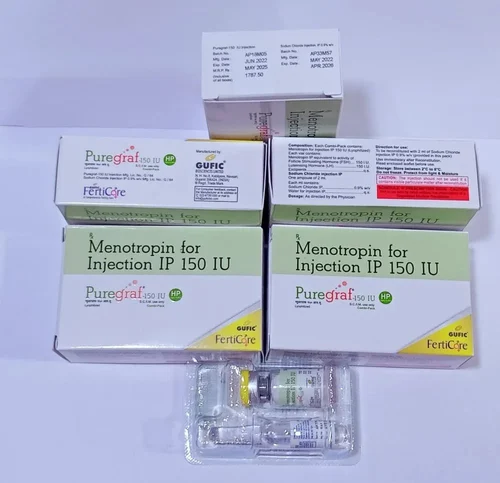
Human Menopausal Gonadotropin (HMG 150 IU)
€ 40,00
In StockBuy premium Human Menopausal Gonadotropin | Prime Pharma online. Restore natural testosterone and fertility. Fast shipping. Order HMG securely today!
Acne
No
Half-Life
24 Hours
Dosage
75-150 IU per injection
Detection Time
About 1 Week
Aromatization
No
Water Retention
No
Hepatotoxicity
No
HBR
No
Product Information
About Human Menopausal Gonadotropin (HMG 150 IU)
Restore Fertility Fast
HMG (Human Menopausal Gonadotropin) is the gold standard for restoring fertility in men after heavy steroid use. Unlike HCG, which only mimics LH (Luteinizing Hormone), HMG contains both LH and FSH (Follicle Stimulating Hormone).
This dual action allows it to directly stimulate the testes to produce sperm (spermatogenesis) and natural testosterone, making it essential for users who are "shut down" or trying to conceive.
Key Benefits:
- Fertility Restoration: Reverses testicular atrophy and infertility.
- Sperm Production: Directly stimulates Sertoli cells via FSH.
- Testosterone Boost: Stimulates Leydig cells via LH.
- Complete PCT: comprehensive recovery of the HPTA axis.
Dosage:
- PCT/Fertility: 75-150 IU injected 2-3 times per week.
- Duration: Typically 3-6 weeks, or until conception occurs.
1. Description
HMG 150 IU (human menopausal gonadotropin, 150 international units per dose/vial) is a gonadotropin preparation containing both follicle-stimulating hormone (FSH) and luteinizing hormone (LH) activity derived from the urine of postmenopausal women (menotropins). It is used primarily in reproductive medicine to stimulate follicular development in women and to support spermatogenesis in men with certain forms of hypogonadism. Typical clinical indications include ovulation induction in anovulatory infertile women, controlled ovarian stimulation for assisted reproductive technologies (ART; e.g., IVF), and treatment of hypogonadotropic hypogonadism in men (in combination with hCG).
Clinical points
- Contains both FSH and LH activity — useful where both activities are desired.
- Administered by subcutaneous (SC) or intramuscular (IM) injection after reconstitution.
- Treatment must be individualized and performed under specialist supervision with appropriate monitoring (serial estradiol measurements and transvaginal ultrasound).
2. How does HMG 150iu work?
Mechanism of action
- HMG provides exogenous FSH and LH. FSH stimulates granulosa cell proliferation and follicular growth in the ovary; LH stimulates theca cells to produce androgens that are aromatized to estrogens by granulosa cells, and LH surge (or hCG mimic) triggers final oocyte maturation and ovulation.
- In men with hypogonadotropic hypogonadism, FSH supports Sertoli cell function and spermatogenesis; LH activity (or co-administered hCG) stimulates Leydig cells to produce testosterone, which supports spermatogenesis and secondary sexual functions.
- By replacing or supplementing endogenous gonadotropins, HMG promotes development of ovarian follicles or spermatogenesis depending on indication.
3. Dosage
General principles
- Dosage is individualized based on indication, patient characteristics (age, weight, ovarian reserve), prior response to gonadotropins, and monitoring results (ultrasound, estradiol).
- Treatment should be prescribed and adjusted only by reproductive specialists. The following are typical starting regimens and common adjustments used in clinical practice — they are illustrative, not prescriptive.
Female — ovulation induction (anovulation, WHO group II)
- Typical starting dose: 75–150 IU SC/IM once daily.
- If using a 150 IU vial, many clinicians start at 75–150 IU/day depending on prior response; lower start in PCOS/young patients to reduce OHSS/multiple pregnancy risk.
- Assess response after ~5–7 days (follicular ultrasound ± estradiol). If inadequate response, dose may be increased by 37.5–75 IU increments.
- Typical duration: until an adequate dominant follicle (generally 1–3 follicles) is achieved, often 5–14 days; when ready, ovulation is triggered by hCG or by timed intercourse/intrauterine insemination as clinically indicated.
Female — controlled ovarian stimulation for ART (IVF/ICSI)
- Typical starting dose: 150–300 IU/day SC/IM, depending on age and ovarian reserve (higher doses for diminished ovarian reserve or poor responders).
- Daily dosing continues until adequate follicular development is achieved; monitoring with ultrasound and estradiol guides dose adjustments.
- Final oocyte maturation is induced with hCG or a GnRH agonist (as per protocol); cycle cancellation if excessive response or other contraindications.
Male — hypogonadotropic hypogonadism (to induce/maintain spermatogenesis)
- Typical regimen: hCG is usually started first to restore intratesticular testosterone; HMG is added to stimulate spermatogenesis.
- HMG dosing example: 75–150 IU SC/IM 2–3 times per week (protocols vary); treatment often continued for months (3–12+ months) until sperm appear in ejaculate and adequate counts are achieved.
- Combination with hCG is standard; dosing and duration individualized.
Special populations and adjustments
- PCOS: start with low dose (e.g., 37.5–75 IU/day if product allows splitting or lower-unit preparations) and increase cautiously to lower OHSS and multiple pregnancy risk.
- Poor responders or advanced maternal age: higher starting doses (e.g., 225–300 IU/day) may be used but with limited expectations.
- Renal/hepatic impairment: no specific dosing guidelines available; use with caution and specialist oversight.
- Pregnancy and breastfeeding: HMG is contraindicated in established pregnancy; stop if pregnancy occurs.
Administration and reconstitution
- HMG is supplied as a lyophilized powder in vials that must be reconstituted with the provided diluent (sterile water for injection or specific solvent recommended by manufacturer).
- Use aseptic technique. After reconstitution, withdraw the prescribed dose into a syringe for SC or IM injection.
- Injection routes: SC is commonly used and generally less painful; IM is an alternative if recommended by product labeling.
- Discard any unused reconstituted solution according to manufacturer instructions and local infection-control policies. Many preparations recommend using reconstituted product immediately or within a short refrigerated window (see Storage).
Monitoring during treatment
- Baseline evaluation: pelvic ultrasound, serum FSH/estradiol, and assessment of contraindications.
- During therapy: serial transvaginal ultrasound to measure follicle number/size and serum estradiol to evaluate response and reduce OHSS risk.
- Stop or reduce dose if excessive follicular development or high estradiol. Counsel to avoid unprotected intercourse if multiple follicles develop unless multiple pregnancy is acceptable/desired.
Always follow specific product labeling and local clinical protocols. These examples are for educational purposes and do not replace medical advice.
4. Side effects
Common (occur more frequently)
- Local injection site reactions: pain, erythema, swelling, bruising.
- Mild systemic: nausea, bloating/distension, breast tenderness, headache, fatigue, mood changes.
- Pelvic discomfort, mild abdominal pain.
Important/serious (less frequent but clinically significant)
- Ovarian hyperstimulation syndrome (OHSS): range from mild (bloating, mild abdominal pain, slight weight gain) to severe (painful ovarian enlargement, ascites, hemoconcentration, oliguria, thromboembolism). Risk factors: young age, PCOS, high ovarian reserve, high estradiol, multiple follicles.
- Symptoms warrant immediate medical assessment: sudden severe abdominal pain, rapid weight gain (>2 kg/48 h), shortness of breath, decreased urine output, severe nausea/vomiting.
- Multiple pregnancy: increased chance of twins or higher-order multiples with ovulation induction or controlled ovarian stimulation. Multiple gestation increases obstetric and neonatal risks.
- Ovarian cyst formation and adnexal torsion (rare but possible).
- Thromboembolic events (rare): increased risk in OHSS or hypercoagulable states.
- Allergic/hypersensitivity reactions (rare): rash, pruritus, anaphylaxis in extreme cases.
Other considerations
- Mood alteration, irritability, or other psychological effects may occur.
- Long-term safety: no consistent evidence of increased ovarian cancer risk attributable to gonadotropin stimulation in fertility treatments, but monitoring and specialist follow-up are standard practice.
Reporting and management
- Any severe adverse event (OHSS signs, thromboembolism, severe allergic reaction) requires immediate medical attention.
- Mild side effects often managed supportively; dose adjustments or cycle cancellation may be required for excessive response.
5. Storage
Unreconstituted (lyophilized powder)
- Store refrigerated at 2–8 °C (36–46 °F) unless manufacturer labeling specifies otherwise.
- Do not freeze. Protect from light and excessive heat.
- Keep in original carton/vial to protect from light until use.
- Observe expiration date on vial and packaging.
Diluent (if provided)
- Store per manufacturer instructions (often room temperature or refrigerated). Use only the provided diluent or the solvent stated in the product insert.
After reconstitution
- Manufacturer guidance varies. Many menotropin products recommend:
- Use reconstituted solution immediately when possible.
- If not used immediately, store reconstituted solution refrigerated (2–8 °C) and use within the time window specified by the product (commonly 24 hours; check labeling).
- Do not freeze reconstituted solution.
- Discard any remaining reconstituted solution after the recommended storage interval.
Safe handling and disposal
- Use aseptic technique for reconstitution and withdrawal.
- Dispose of needles/syringes and unused medicinal product per local regulations for sharps and pharmaceutical waste.
Final notes
- Always follow the specific product leaflet and the prescribing clinician’s instructions for dosing, monitoring, reconstitution, and storage, as formulations and manufacturer recommendations can differ.
- HMG treatment should be prescribed and supervised by clinicians experienced in reproductive endocrinology/andrology because of risks (OHSS, multiple pregnancy) and the need for individualized dose adjustment and monitoring.
Dosage
Recommended
75-150 IU per injection
Half-Life
24 Hours
Benefits
- Laboratory tested for purity
- Pharmaceutical quality guaranteed
- Discrete and secure shipping
- Excellent customer service
- Fast delivery throughout Europe
Free Shipping
Free shipping on orders over €200.
Delivery Guarantee
Free reshipment if your order does not arrive.
Fast Delivery
Shipped within 24h. Delivery 48-72h in NL & BE.
Bitcoin Payment
Pay securely and stay completely anonymous with Bitcoin.
Secure Checkout
Secured SSL connection for all transactions.
Authentic
Authenticity verification for all our products.