BPC-157
Clinical Overview
Overview
BPC-157 (Body Protection Compound-157) is a synthetic peptide derived from a naturally occurring gastric juice protein. It was first isolated from human gastric juice and subsequently synthesized for experimental use. Since its initial characterization in the late 20th and early 21st centuries, BPC-157 has attracted attention in preclinical research because of reported tissue-protective, pro-healing, and cytoprotective effects in a range of animal models.
Common uses (mostly investigational and off-label) include:
- Experimental treatment for gastrointestinal injuries and inflammatory bowel disease (IBD) models.
- Promotion of soft tissue repair — tendon, ligament, muscle, and skin injury models in animals.
- Protection against gastric ulcers and mucosal lesions.
- Reduction of inflammatory responses and modulation of wound healing processes.
Drug classification:
- Peptide/protein biologic (small, synthetic peptide derived from a fragment of a larger endogenous gastric protein). It is not a steroid, growth hormone, or small-molecule drug classically categorized as an anabolic-androgenic agent.
Chemical Properties
BPC-157 is a short, 15–amino-acid peptide (a fragment of a naturally occurring gastric protein). Because it is a peptide, many chemical properties reflect its amino-acid composition rather than a simple single chemical formula.
-
Molecular structure and formula:
- BPC-157 is a linear peptide composed of 15 amino acids. Reported molecular mass is approximately 1,400–1,500 Da (commonly cited ~1,418–1,420 Da depending on counterions and salt forms).
- As a peptide, the exact empirical formula depends on protonation states and any salt forms; simple elemental formulae are not commonly tabulated for such peptides in consumer literature.
-
Physical characteristics:
- Appearance: typically supplied as a lyophilized (freeze-dried) white to off-white powder for research use.
- Solubility: soluble in water and aqueous buffers; stability depends on pH, temperature, and presence of proteases.
-
Ester type:
- Not applicable. BPC-157 is not an esterified compound; it is a linear peptide with free amino- and carboxyl-termini (or in some formulations, protected/acetylated or amidated termini depending on specific synthesis strategies).
-
Half-life and detection time:
- Plasma half-life in humans is not well characterized because of limited human pharmacokinetic data. In animal models, BPC-157 shows rapid clearance from plasma but prolonged biological effects in tissues.
- Detection windows in biological matrices (blood, urine) are not standardized; validated assays for routine diagnostic or forensic detection are not commonly available. Detection time is therefore uncertain and highly assay-dependent.
Mechanism of Action
BPC-157's mechanisms are incompletely understood. Most mechanistic data come from in vitro experiments and animal models; human mechanistic data are scarce.
-
How it works in the body:
- Cytoprotection: BPC-157 appears to protect cells and tissues from various chemical and physical insults, particularly in gastric and intestinal mucosa but also in other tissues.
- Pro-healing: It has been reported to accelerate wound healing, tendon and ligament repair, and muscle regeneration in preclinical models.
- Vascular effects: Promotes angiogenesis and endothelial cell function in healing tissues, aiding restoration of blood supply to injured sites.
-
Receptor binding and activity:
- A specific, canonical receptor for BPC-157 has not been definitively identified. Proposed actions involve modulation of multiple intracellular signaling pathways rather than a single classical receptor-ligand interaction.
- Reported molecular effects include modulation of nitric oxide (NO) pathways, alterations in cyclooxygenase (COX) activity, and influences on growth factor signaling (e.g., VEGF-related angiogenic signaling).
-
Anabolic/androgenic ratio:
- Not applicable. BPC-157 is not an androgenic anabolic steroid and does not have an established anabolic/androgenic ratio. Its putative pro-regenerative effects are not mediated by classical androgen receptor signaling.
-
Metabolic pathway:
- As a peptide, BPC-157 is likely subject to proteolytic degradation by peptidases and proteases in plasma and tissues. Metabolism appears rapid in circulation, but tissue retention and indirect modulation of tissue repair processes can produce sustained effects.
- Full characterization of metabolites and metabolic pathways in humans is lacking.
Medical Information
Most published data on BPC-157 derive from in vitro studies and animal experiments. No large-scale, well-controlled human clinical trials have established therapeutic indications, dosing standards, or long-term safety profiles.
-
Therapeutic applications (experimental/preclinical):
- Gastrointestinal protection: reduction of gastric lesions, protection against experimentally induced colitis, and attenuation of intestinal mucosal damage.
- Soft tissue repair: accelerated healing of tendons, ligaments, muscles, and skin wounds in animal models.
- Neuroprotective and nociceptive effects: reported reductions in certain pain models and protection in some neural injury models.
- Possible protective actions in organ injury models (e.g., liver, kidney) in preclinical work.
-
Typical dosage ranges (reporting of experimental/off-label use; not approved dosing):
- Dose-response data are limited and vary across species and studies. Preclinical animal dosing is typically reported in µg/kg ranges, while off-label human use reported in informal sources tends to cite microgram dosages (e.g., 200–1,000 µg/day) administered subcutaneously or intramuscularly.
- There is no approved, evidence-based human dosing regimen established by regulatory agencies.
-
Administration routes:
- Subcutaneous (SC) or intramuscular (IM) injection has been commonly used in animal studies and by off-label human users.
- Oral administration is sometimes reported because the peptide is derived from a gastric protein; there is interest in oral stability but formal clinical bioavailability studies are limited.
- Topical application and local injection into injury sites have been used experimentally.
-
Duration of use:
- In preclinical studies, treatment durations vary from single-dose administration to repeated dosing over days to weeks, depending on the model of injury. Off-label use duration reported anecdotally ranges from several days to multiple weeks or longer. Clinical duration and long-term outcomes are not well defined.
Safety Profile
Safety information is limited by the absence of large-scale clinical trials. Most safety data come from animal studies and limited human case reports or anecdotal sources.
-
Common side effects (reported anecdotally or in small studies):
- Local injection-site reactions (pain, redness, irritation).
- Occasional transient systemic effects reported anecdotally (e.g., headache, fatigue); systematic data are lacking.
-
Serious adverse reactions:
- There are few well-documented serious adverse events in the open literature; however, rigorous surveillance and long-term safety studies are absent.
- Theoretical concerns based on mechanism:
- Angiogenesis promotion raises a theoretical risk that BPC-157 could support growth of neoplastic tissue or exacerbate proliferative disorders; this has not been conclusively demonstrated in controlled studies but is a biologically plausible concern.
- Immunogenicity: as a synthetic peptide, repeated administration could induce immune responses in some individuals, potentially leading to allergic or neutralizing antibody formation.
-
Drug interactions:
- Comprehensive interaction data are not available. Potential interactions could stem from modulation of:
- Nitric oxide pathways (which may affect blood pressure or interact with nitrates or NO-modulating drugs).
- Angiogenic or growth factor signaling (theoretical interactions with agents affecting angiogenesis or wound healing).
- Concomitant use with other experimental growth-promoting or regenerative agents has not been systematically studied.
- Comprehensive interaction data are not available. Potential interactions could stem from modulation of:
-
Contraindications:
- Lack of robust clinical data prevents a full contraindication list. Potential contraindications based on mechanism and limited evidence could include:
- Active malignancy or known proliferative neoplastic disease (due to angiogenesis and tissue-growth promotion).
- Pregnancy and lactation — safety has not been established.
- Known hypersensitivity to peptide products or components of formulations.
- Clinical judgment should consider comorbid conditions, concurrent medications, and the incomplete safety database.
- Lack of robust clinical data prevents a full contraindication list. Potential contraindications based on mechanism and limited evidence could include:
Legal Status
Regulatory classification and availability vary by jurisdiction. Status may change over time; the statements below reflect the general regulatory landscape known from available information in research and regulatory communications.
-
Regulatory classification:
- BPC-157 is not an approved therapeutic agent by major regulatory agencies (e.g., U.S. Food and Drug Administration) for any medical indication.
- It is frequently marketed and sold as a “research chemical,” peptide for laboratory use, or via channels that explicitly state non-human research use only.
-
Prescription requirements:
- Because it is not approved as a medication in many jurisdictions, there is typically no formal prescription pathway or approved pharmaceutical product associated with BPC-157. Sales and distribution channels for research-use peptides vary; in some places access is limited to research institutions, while in others it is more readily available through online vendors labeling the product for “research use only.”
-
Sports anti-doping status:
- Anti-doping agencies (for example, the World Anti-Doping Agency, WADA) maintain evolving prohibited lists. Many novel peptides, growth factors, and agents with putative regenerative or performance-enhancing effects fall under broad categories of prohibited substances (peptide hormones, growth factors, and related substances) when used to enhance performance or recovery.
- Athletes should consult the up-to-date prohibited list and their sport’s governing body; use of unapproved peptides may carry a risk of anti-doping rule violation.
References and Research Context
- Most published data on BPC-157 are preclinical (rodent and other animal models) showing protective and reparative effects across multiple tissues and injury types.
- Well-powered, randomized clinical trials in humans are lacking; consequently, efficacy and safety in human therapeutic contexts remain to be established.
- Research priorities include pharmacokinetic characterization in humans, dose-finding studies, controlled efficacy trials for specific indications (e.g., IBD, tendon repair), and comprehensive safety monitoring including long-term surveillance.
Note: The available literature on BPC-157 is dynamic, with new preclinical reports continuing to appear. Readers should consult current peer-reviewed studies and regulatory guidance for the latest validated information.
science Chemical Properties
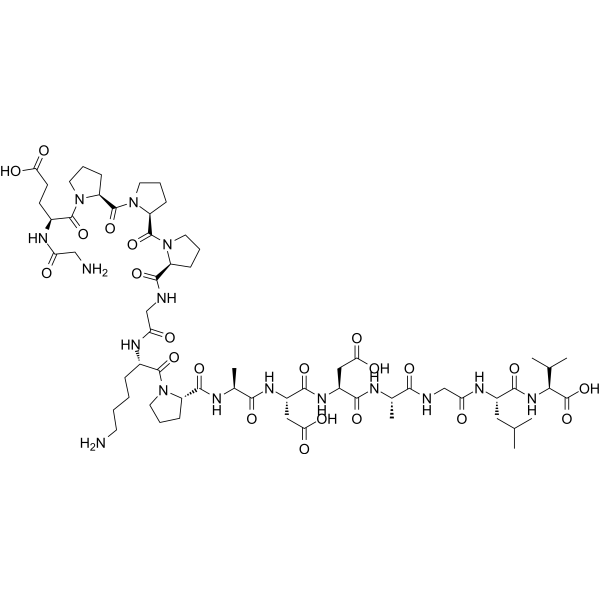
2D Structure
Molecular Formula
scienceC62H98N16O22
Molar Mass
science1419.5 g/mol
Active Half-Life
science< 4 Hours
Anabolic/Androgenic Ratio
scienceN/A (Peptide)
bolt Mechanism of Action
BPC-157 (Body Protection Compound) is a peptide derived from stomach acid. It is renowned for its ability to accelerate the healing of soft tissue, tendons, and the gut.
- Angiogenesis: Promotes formation of new blood vessels.
- Gut Health: Originally found to heal ulcers and gut lining.
Cancer
Avoid if active cancer present (due to angiogenesis).
medication Dosing Protocol
| Experience Level | Daily Dosage | Cycle Duration |
|---|---|---|
| Healing | 250-500 mcg | 4-6 Weeks |
* Can be injected locally or systemically (subq).
security Safety Profile
warning Common Side Effects
-
verified_user
Safe
Virtually no reported side effects.
dangerous Severe/Rare Side Effects
Disclaimer: This content is for informational and educational purposes only. It does not constitute medical advice.